Syphilis
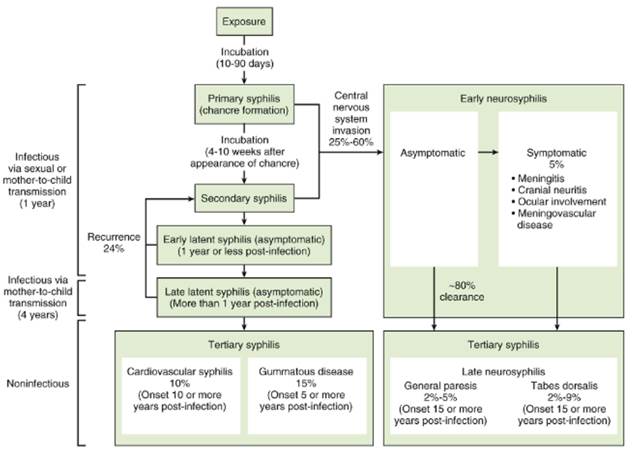
• Traditional categorisation:
o Primary
o Secondary
o Latent
- Early latent (<1-2 years)
- Late latent (>1-2 years)
o Tertiary
• Treponeme often invades CNS quite early in disease – it is then a question of whether it manifests.
• Neurosyphilis:
o Asymptomatic vs symptomatic
o Early (1-2 years after primary infection) vs Late
Clinical features
Primary
• Painless
papule at site of inoculation
• Develops
into chancre - smooth base, raised firm border.
o
Heals over 2-8 weeks
• Inguinal lymphadenopathy
Secondary
• 6-12
weeks
• Disseminated
infection
• Diffuse
rash
o
Nonpruritic macules, papules or pustules
o
Often involving palms and soles
o
Mucocutaneous lesions
o
Patchy alopecia
• CNS involvement (40%) – see below
Tertiary
• Late neurosyphilis ~ 8-10% (see below)
• Cardiovascular
• Gummatous disease
Neurosyphilis manifestations
•
Early (or late) (typically 1-10 years after
infection)
o Meningovascular syphilis - A form of vasculitis of small or medium size arteries
- Meningitis (most common)
- Encephalitis
- Stroke
- Cranial nerve palsies
- Ocular involvement
•
Late neurosyphilis (decades after primary
infection)
o General paresis (Brain involvement)
- Progressive dementia, psychosis, personality change, tremor, dysarthria (with halting speech)
o Tabes dorsalis (Spinal cord involvement)
- Ataxic gait with loss of proprioception, Argyll Robertson pupils, paraparesis with areflexia in the legs.
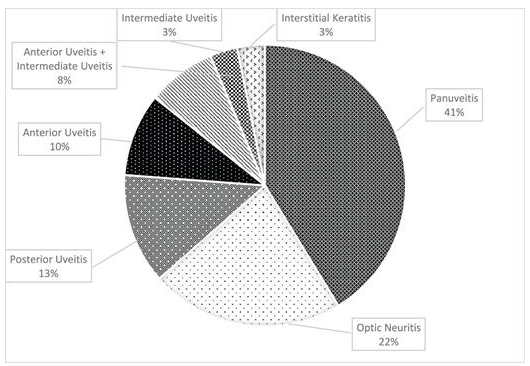
Ocular
• Uveitis
• Retinitis
• Optic neuritis

•
59 cases
•
90% Male
•
RPR – median 1:128 (lowest 1:16)
•
Median time to pres – 1
month
•
30% had other Sx of
secondary syphilis
•
Bilateral in 56%
•
All but 4 had improved VA
Diagnosis
• Serology
o
Treponemal Ab = has the patient been exposed
- FTA-ABS
- TPPA
- EIA
o
Non-treponemal Ab ≈ disease activity. May not be specific.
- RPR
- VDRL
o
RPR used to monitor treatments
- 4
fold drop indicates adequate response
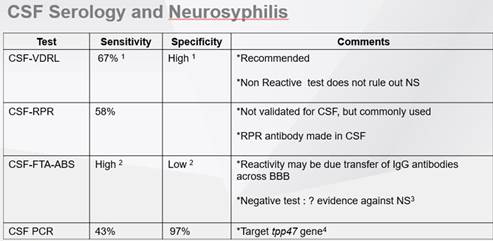
• CSF
o
Elevated protein 1000-2000g/L
o
Lymphocytic pleocytosis (200-400cells/uL)
o
Oligoclonal bands often present
• Ocular
o
With isolated ocular signs and symptoms,
reactive syphilis serologic results, and confirmed ocular abnormalities on
examination diagnostic CSF examination arguably not necessary, as nearly 40% of
patients would have no CSF abnormalities.
o
Consider CSF examination if no ocular findings
on examination
Treatment
Neurosyphilis
• Benzylpenicillin 1.8g IV 4 hourly for 15 days
• Jarisch–Herxheimer reaction
o is traditionally associated with antimicrobial treatment of syphilis.The reaction is also seen in the other diseases caused by spirochetes: Lyme disease, relapsing fever, and leptospirosis
o Consider prophylaxis with anti-inflammatories or steroids
o